When a strata building is due for a repaint, the focus tends to fall on the exterior. The façade is what the street sees, what valuers notice, and what dominates the committee conversation. But inside, a quieter and often more costly problem is developing. High-traffic common areas deteriorate at a fundamentally different rate to external surfaces, and treating them the same way leads to poor results, shorter coating lifespans, and avoidable expense.
Why Traffic Volume Changes Everything
External walls face UV exposure, rain, and temperature variation. These are predictable stressors. Interior high-traffic surfaces face something different: constant, concentrated physical contact. Corridors absorb trolleys, furniture, prams and bicycles grazing the walls. Stairwells take repeated scuffing from bags, shoes, and handrails. Car park walls and columns are struck by vehicles and equipment on a regular basis.
Standard acrylic wall paint is not engineered to withstand this level of mechanical stress. Applied to a corridor or stairwell, it will show wear within a fraction of the time it would on an exterior wall, regardless of product quality or application.
Specifying the Right Coating for the Right Surface
High-traffic interior surfaces require coatings specifically formulated for durability and washability. Semi-gloss and gloss finishes are typically preferred in corridors and stairwells, offering better resistance to scuffing and easier cleaning than flat or low-sheen alternatives. For surfaces subject to heavy impact, such as car park walls, columns, and basement structures, two-pack epoxy systems provide a significantly harder film that resists abrasion, moisture, and chemical exposure from vehicle fluids.
Car park floors require a different specification again. They must withstand vehicle loads, tyre movement, oil and fluid contamination, and water ingress. A purpose-engineered epoxy or polyurethane floor coating is the appropriate product. Standard paint will fail quickly and create both a maintenance liability and a safety risk.
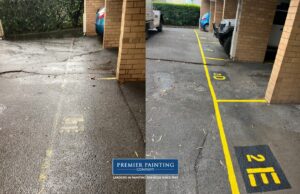
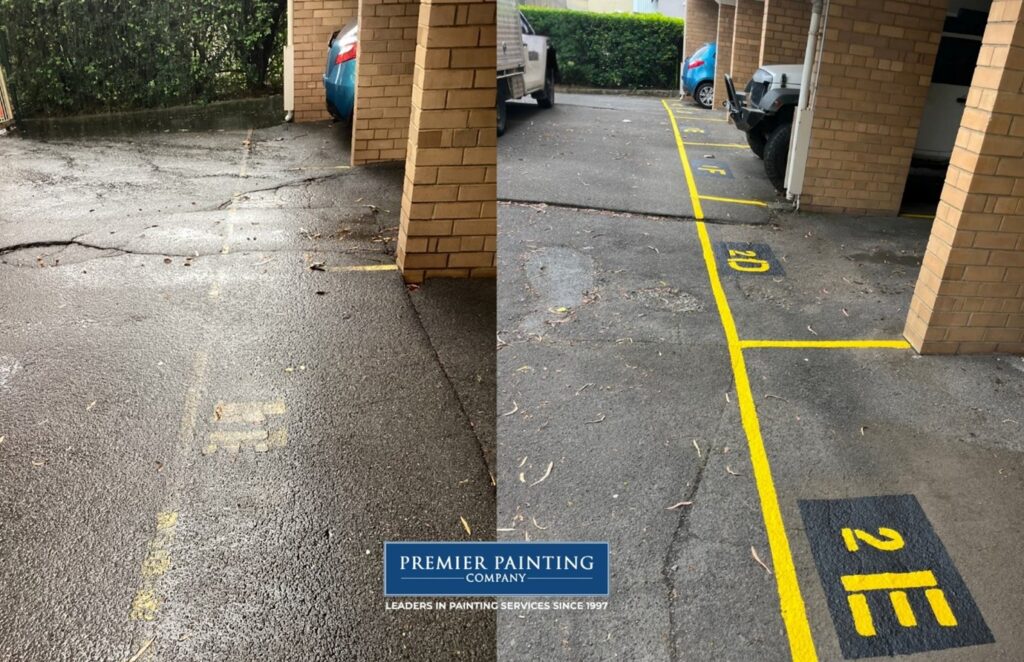
Line marking adds another layer of specification. Bay markings, directional arrows, disabled spaces, and pedestrian zones must be applied using purpose-formulated line marking paint that adheres correctly to the floor system and resists tyre wear over time. It should be scoped and budgeted as part of the works, not treated as an afterthought.
Surface Preparation Is Even More Critical at High Traffic
On high-traffic surfaces, preparation determines how long the coating will last. Contamination from cleaning products, oils, and general use must be fully removed before any coating is applied. Existing paint that has lost adhesion must be stripped rather than painted over. Cracks and impact damage must be properly repaired. Any shortcut will be visible within months on a high-contact surface, whereas on a low-traffic exterior wall the same shortcut might not show for years.
What This Means for Strata Committees
When reviewing a painting proposal, committees should confirm that the scope distinguishes between surface types and specifies appropriate products for each area. A proposal that applies a single product across all surfaces is a signal that the contractor has not properly assessed the building. The right specification protects the investment, extends the maintenance cycle, and avoids returning to site prematurely.
Premier Painting assesses every surface type during the pre-paint inspection and specifies products accordingly, with a dedicated Project Manager overseeing the scope from start to finish.
For advice on your building’s next painting program, visit www.premierpainting.com.au/strata or email [email protected].